

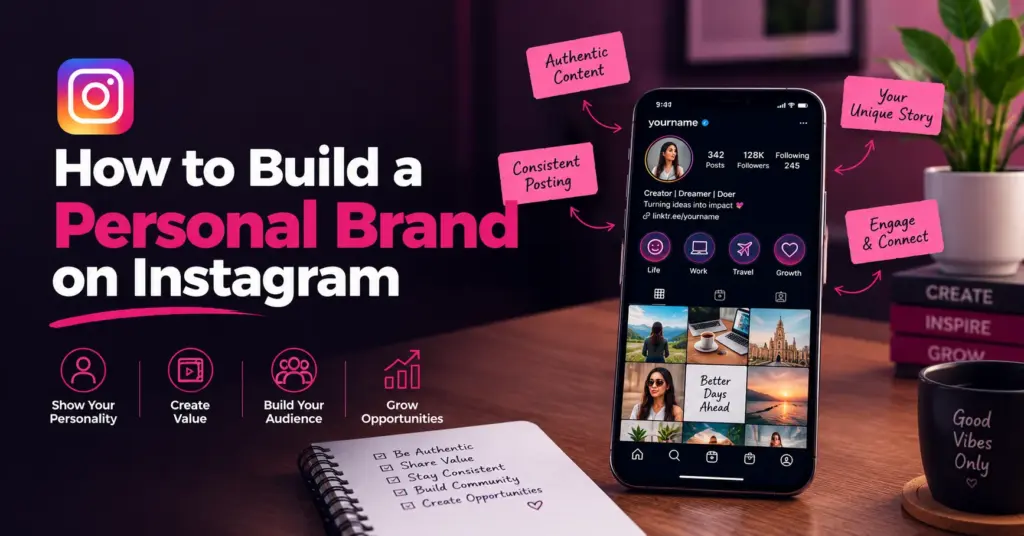
You do not need to be famous to build a personal brand. You do not need a big team or a fancy camera either. You only need a clear idea, a simple plan, and the habit of showing up.
Instagram is one of the best places to do this. It is a visual app, so people can see your face, hear your voice, and feel your style in just a few seconds. That is hard to do on most other platforms.
In this guide, I will show you how to build a personal brand on Instagram from zero. I will keep the words simple and the steps clear. If you are a beginner, you are in the right place.
Here is what you will learn:
- What a personal brand really is
- Why Instagram works so well for it in 2027
- How to pick your niche and your message
- How to set up your profile the right way
- What content to post, and how often
- How to grow, earn trust, and turn followers into customers
- The mistakes that slow most people down
Let us start.
What Is a Personal Brand on Instagram?
A personal brand is what people think and feel when they see your name. It is your skills, your story, your values, and the way you show them online.
On Instagram, your personal brand lives in many small things:
- Your name and profile photo
- Your bio
- The topics you post about
- The way you talk in Reels and captions
- The colors and style of your posts
- How you reply to comments and messages
When all these things match, people start to remember you. They think, “Oh, this is the person who teaches simple money tips.” Or, “This is the coach who helps new moms get fit.” That memory is your brand.
A personal brand is not the same as a business brand. A business brand is built around a company logo and products. A personal brand is built around you. People follow you because they like your ideas and trust your voice.
Who Needs a Personal Brand?
Almost anyone can gain from one. Here are some common examples:
- Freelancers like writers, designers, and video editors who want more clients
- Coaches and consultants who sell their time and advice
- Small business owners who want people to trust the face behind the shop
- Job seekers who want to stand out from other people with the same skills
- Creators who want to earn through brand deals or their own products
- Experts like doctors, lawyers, teachers, and finance people who want to share what they know
If you want people to find you, trust you, and pick you, a personal brand helps.
Why Build Your Personal Brand on Instagram in 2027?
There are many social apps. So why Instagram? Here are the main reasons.
1. A Huge Audience Is Already There
Instagram has a very large global user base. Meta has said the app has crossed the 3 billion monthly users mark. That means your future followers and customers are already on the app. You just need to reach them.
2. It Is Built for Showing Who You Are
Instagram mixes photos, short videos, Stories, and chats in one place. You can show your work in a Reel, share your day in Stories, and answer questions in direct messages. This mix helps people feel they know you.
3. Short Video Gives Small Accounts a Real Chance
Reels are shown to people who do not follow you yet. That means a new account can still get seen if the video is good. You do not need thousands of followers to start getting views.
4. Search Is Now a Big Part of Instagram
People now use Instagram like a search engine. They type topics like “budget travel tips” or “beginner yoga” and watch what comes up. Instagram looks at your caption, your spoken words, and your profile to understand what your content is about. This is why clear keywords matter, and I will show you how to use them below.
5. It Leads to Real Money and Real Chances
Brands look for creators on Instagram. Clients find freelancers there. Recruiters look at profiles. Followers buy courses, books, and services. A strong personal brand opens these doors.
A quick note: app features and numbers change often. Instagram updates its tools many times a year. Before you plan anything big, take a minute to check Instagram’s own help pages and the official Instagram creators blog for the latest rules.
Step 1: Get Clear on Your Goal
Before you post anything, ask yourself one question: Why do I want a personal brand?
Your answer shapes everything else. Here are some goals people pick:
- Get more clients for my service
- Sell my own product or course
- Get a better job
- Become a trusted voice in my field
- Earn money from brand deals
Pick one main goal for the first 90 days. You can have more goals later. But one clear goal keeps your content focused.
Here is a simple way to write it down:
“In the next 90 days, I want to ______ by helping ______ with ______.”
For example: “In the next 90 days, I want to get 5 new clients by helping small shop owners with simple Instagram posts.”
When you know your goal, it is easier to decide what to post and what to skip.
Step 2: Find Your Niche and Your Audience
This is the step where many beginners get stuck. They try to talk to everyone. But when you talk to everyone, nobody feels you are talking to them.
What Is a Niche?
A niche is a small, clear area you focus on. It is the place where your skills, your interests, and people’s needs meet.
Ask yourself these three questions:
- What am I good at – Think about your job, your hobbies, and things people ask you for help with.
- What do I enjoy talking about – You will make hundreds of posts. You need a topic you do not get tired of.
- What do people need or want – A topic only works if someone cares about it.
Where your answers overlap, you will find your niche.
Make Your Niche Smaller
“Fitness” is too wide. “Home workouts for busy moms who sit all day” is much better. The smaller your focus, the easier it is for the right people to say, “This is for me.”
Here are some examples of wide topics and sharper versions:
- Wide: Money. Sharp: Simple saving tips for first-job salaries.
- Wide: Food. Sharp: 20-minute vegetarian dinners for students.
- Wide: Marketing. Sharp: Instagram tips for small candle and gift shops.
- Wide: Career. Sharp: Resume tips for fresh graduates.
You can always grow wider later. It is much harder to start wide and then shrink.
Know Your Ideal Follower
Now picture one real person you want to help. Give them a name if it helps. Then answer these:
- How old are they, and what do they do?
- What problem keeps them stuck?
- What do they search for on their phone?
- What words do they use to talk about that problem?
- What would make them trust you?
Write your answers in a note. You will use this note again and again when you plan content.
Quick Check on Your Competition
Look at five to ten accounts in your niche. Do not copy them. Study them. Ask:
- What topics do they post about most?
- Which posts get the most comments and saves?
- What do they never talk about?
That last question is gold. The things nobody covers are your content gaps. For example, many accounts post tips, but few show the real behind-the-scenes mistakes and lessons. If you share those honestly, you stand out.
Step 3: Write Your Personal Brand Statement
A personal brand statement is one or two short lines that tell people who you help and how. It keeps you focused. It also becomes the base of your bio.
Use this simple formula:
“I help [who] to [get what result] through [your method or skill].”
Here are a few examples:
- “I help new freelancers get their first paying client through simple Instagram posts.”
- “I help busy parents cook healthy dinners in 20 minutes with easy recipes.”
- “I help fresh graduates write resumes that get interview calls.”
Tips for a Strong Statement
- Be clear, not clever – A beginner should understand it in five seconds.
- Name the person you help – “Busy parents” is better than “people.”
- Focus on the result – People care more about what they will get than about what you do.
- Keep it true – Only promise what you can really deliver.
Try writing three versions and pick the one that feels most like you.
Step 4: Set Up Your Instagram Profile the Right Way
Your profile is your front door. Most people decide in about three seconds if they will follow you. Let us make those seconds count.
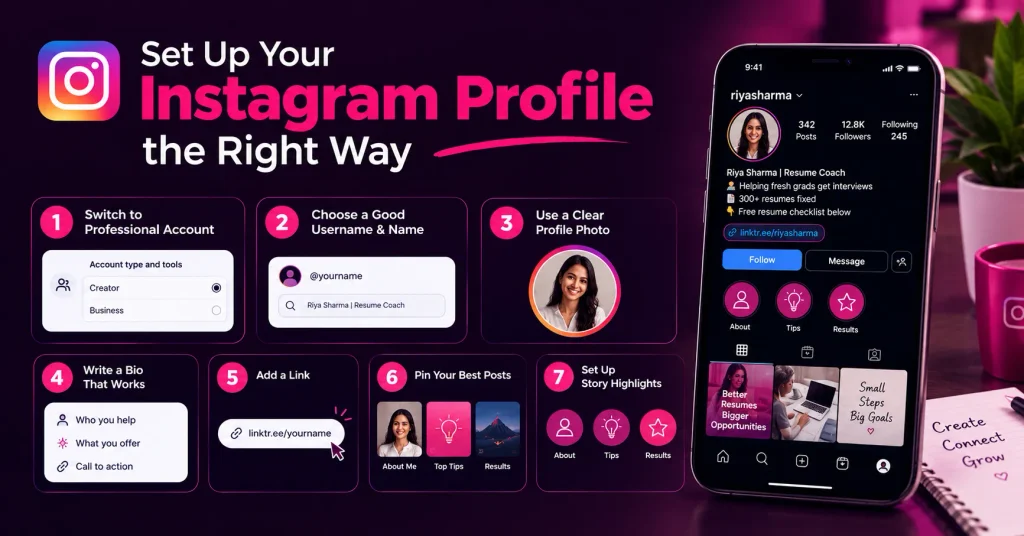
Switch to a Professional Account
Go to your settings and switch to a professional account. You can pick Creator or Business. This gives you insights, which show you who watches your content and what works. You can switch back at any time.
Pick a Good Username and Name
- Use your real name or a name that is close to it, so people can find you.
- Keep it short and easy to say out loud.
- Avoid too many numbers, dots, and underscores.
- Use the same handle on other apps if you can.
The Name field on Instagram is searchable. Add your main keyword there. For example: “Riya Sharma | Resume Coach” is better than just “Riya Sharma.” This helps people find you when they search for resume help.
Use a Clear Profile Photo
Use a bright, clear photo of your face. Look at the camera and smile if it fits your style. Do not use a logo for a personal brand. People connect with faces. Make sure your face is easy to see even in a tiny circle.
Write a Bio That Works
Your bio has 150 characters. That is very short, so every word counts. A good bio answers three things:
- Who do you help?
- What do you help them get?
- What should they do next?
Here is a simple bio layout:
- Line 1: Who you help and the result
- Line 2: A proof point or a short trust line
- Line 3: A clear call to action
Example bios:
- “Helping fresh grads land interviews | 300+ resumes fixed | Free resume checklist below”
- “Healthy 20-minute dinners for busy parents | Recipe creator | New recipe every week”
- “I teach small shop owners Instagram basics | Reels, posts, and simple plans | Free guide below”
(Only use numbers that are true. If you do not have proof yet, say what you teach instead.)
Add a Link
Use the link area to send people to one place. This could be your website, a free guide, a booking page, or a simple link page. Do not put ten links if one will do. A clear next step gets more clicks than a long list.
Pin Your Best Posts
You can pin posts to the top of your profile grid. Use this space smartly. Pin three posts that show new visitors who you are, what you teach, and why they should follow you. For example: one intro post, one popular tip, and one proof or result.
Set Up Story Highlights
Highlights stay on your profile. Create a few with simple names such as “Start Here,” “Tips,” “Results,” and “About Me.” Use clean cover images in the same colors. This helps a new visitor understand you quickly.
Step 5: Build Your Brand Look and Voice
When people see your post in their feed, they should be able to guess it is yours, even before they read your name. That comes from a steady look and voice.
Pick Simple Colors and Fonts
Choose two or three colors and one or two fonts. Use them in your covers, text on videos, and quote posts. Free tools like Canva make this easy. Do not change your style every week. Steady is better than fancy.
Find Your Voice
Your voice is how you sound when you talk and write. Ask yourself:
- Am I friendly and casual, or calm and professional?
- Do I use humor?
- Do I use short, plain sentences?
The easiest way is to write the way you speak. Read your caption out loud. If it sounds odd, change it. Beginners trust people who explain things in plain words.
Be Yourself, but Be Clear
People can feel when a person is acting. You do not have to share everything about your life. You just need to be honest about what you know, what you are still learning, and what you stand for.
Step 6: Choose Your Content Pillars
Content pillars are the three to five main topics you post about again and again. They stop you from guessing what to post each day.
Here is a simple set of pillars that works for most people:
Pillar 1: Teach (Education)
Share tips, how-to steps, checklists, and simple lessons. This shows you know your topic. Teaching posts are often saved and shared, which helps more people find you.
Example: “3 mistakes that make your resume go to the trash.”
Pillar 2: Show Your Proof (Results and Trust)
Share client wins, before-and-after stories, case studies, reviews, or your own results. Proof makes people trust you. If you are new and have no client results, show your own progress or a small test you ran.
Example: “I posted every day for 30 days. Here is what happened.”
Pillar 3: Share Your Story (Personal)
Tell people why you started, what went wrong, and what you learned. Stories build a link between you and your followers. This is the part that makes your brand feel human.
Example: “Why I quit my job to teach Instagram.”
Pillar 4: Share Your Views (Opinion)
Talk about what you believe in your field. A calm, honest opinion helps people remember you. You do not need to be loud or fight with others. Just be clear.
Example: “Why I do not believe in posting five times a day.”
Pillar 5: Talk With Your Audience (Community)
Ask questions, run polls, answer comments, and use Q&A stickers. This builds a bond and gives you ideas for new posts.
Example: “What is the hardest part of starting on Instagram? Tell me below.”
A good mix to start with is about 40 percent teaching, 20 percent proof, 20 percent story, 10 percent opinion, and 10 percent community. This is only a starting point. Check your insights after a month and adjust.
Step 7: Pick the Right Content Formats
Instagram gives you many ways to post. Each one does a different job.
Reels: Your Best Tool to Reach New People
Reels are short videos. They are the main way new people find you. In 2025, Instagram allowed Reels to be longer, up to three minutes, so you can now teach more in a single video. But short and clear still tends to win.
Tips for better Reels:
- Hook people in the first two seconds – Start with the result or the problem. For example: “Stop writing your bio like this.”
- Use simple words on the screen – Many people watch with the sound off, so add captions.
- Teach one idea per video – Do not try to fit everything in.
- Show your face – This is a personal brand, so people need to see you.
- End with a small next step – Ask them to save, share, or follow for more.
You can also use the Trial Reels tool if it is available on your account. It lets you test a Reel with people who do not follow you before showing it to your followers. This is useful when you want to try new ideas without worry.
Carousels: Best for Teaching and Saves
Carousels are posts with many slides. People swipe through them. They work well for step-by-step guides, lists, and simple lessons. People often save them to read again, which is a strong signal to Instagram that the post is useful.
Tips for good carousels:
- Make slide one a strong hook, like “7 bio mistakes to fix today.”
- Put one idea on each slide.
- Use big, easy-to-read text.
- Finish with a summary and a call to action.
Stories: Best for Trust and Daily Contact
Stories vanish after 24 hours, so they feel casual. They are great for behind-the-scenes clips, quick tips, polls, and answering questions. People who watch your Stories are usually your warmest followers. This is where trust grows fast.
Single Photos and Text Posts
A simple photo with a strong caption can still work. Use them for personal stories, quotes, or announcements. Do not skip them just because video is popular.
Live Videos
Going live lets you talk with your audience in real time. You can answer questions, give a short training, or chat with a guest. Lives feel real and build deep trust. You do not need to do them often. Even one Live a month can help.
Broadcast Channels
If you have a growing audience, a broadcast channel lets you send updates to followers who join. It is a good way to share news, polls, and early looks at your work.
Step 8: Plan Your Content (A Simple Weekly Plan)
A plan saves you from the “what should I post today?” stress. Here is a simple weekly plan for beginners. You can start smaller if this feels like too much.
- Monday: A teaching carousel
- Tuesday: A Story with a poll or question
- Wednesday: A Reel with one quick tip
- Thursday: A personal story post or Story set
- Friday: A Reel that shows proof or a result
- Saturday: A light post, like a quote or a behind-the-scenes photo
- Sunday: Rest, reply to comments, and plan next week
How Often Should You Post?
There is no magic number. Most beginners do well with three to five feed posts or Reels each week, plus a few Stories. What matters most is that you can keep it up. A steady plan you can follow for six months beats a hard plan you quit after two weeks.
Batch Your Work
Batching means doing similar tasks at one time. For example, pick one afternoon to film four Reels, and another hour to write captions. This saves a lot of time and keeps your style steady.
Keep an Idea Bank
Open a note on your phone. Whenever you get an idea, a question from a follower, or a good lesson from your day, add it. When it is time to plan, you will have plenty to pick from.
Step 9: Write Captions and Use Keywords the Smart Way
Your captions do two jobs. They help people understand your post, and they help Instagram understand what your account is about.
Use Keywords Naturally
Think about the words your ideal follower would type. If you teach resume writing, words like “resume tips,” “fresher resume,” and “interview” are your keywords. Place them in:
- Your name field
- Your bio
- The first line of your caption
- The words you say in your Reels
- The text on your video
- Your alt text for photos
Do not stuff keywords. Write like a human. If a sentence sounds odd, rewrite it.
Use Hashtags Lightly
Hashtags still help a little, but they matter less than before. Instagram has said that a small number of relevant tags is enough. Use three to five hashtags that match your post. Skip the huge, empty ones.
Start With a Hook
The first line of your caption is what people see before they tap “more.” Make it count. Ask a question, share a bold line, or promise a clear result.
End With One Clear Action
Tell people what to do next. Ask them to save the post, comment with their answer, share it with a friend, or visit your link. One clear action works better than three.
Step 10: Grow Your Audience the Right Way
Growth takes time. But there are clear habits that speed it up.
Focus on Saves, Shares, and Comments
Instagram looks at how people react to your content. Likes are nice, but saves, shares, and real comments tell Instagram that your post is useful. Create content that people want to keep or send to a friend. For example, checklists, templates, and step-by-step guides.
Reply to Every Comment You Can
In the first hour after you post, try to reply to comments. This starts a chat, shows people you care, and gives your post extra life. It also builds the kind of bond that makes followers loyal.
Use Direct Messages With Care
DMs are a powerful way to build trust. Thank new followers. Answer questions kindly. But never spam people with sales messages. Be helpful first.
Work With Other Creators
Use the Collab feature to share a post with another account. The post shows on both profiles, so you reach both audiences. Pick partners who share your audience but are not direct rivals. A guest Live or a joint Reel are good places to start.
Show Up in the Right Places
Comment with useful ideas on posts from bigger accounts in your niche. Do not leave empty comments like “nice post.” Add real value. People often check the profile of a thoughtful commenter.
Share Your Account Beyond Instagram
Put your Instagram link in your email signature, your LinkedIn profile, your website, and your other social pages. Mention it in talks and calls. People who already know you are the easiest to turn into followers.
Be Patient With Numbers
Many accounts feel stuck in the first few months. That is normal. Focus on getting better with each post. Review your insights every month and ask: which posts got the most saves and shares? Make more like those.
Step 11: Build Trust With EEAT
EEAT stands for Experience, Expertise, Authoritativeness, and Trust. It started as a Google idea for judging content quality, but it is also a great guide for any personal brand. People follow those they trust. Here is how to show each part on Instagram.
Experience
Show that you have really done the thing. Share real stories, real screenshots, real mistakes, and real lessons. A post that says “Here is what I tried and what went wrong” feels far more honest than a perfect tip list.
Expertise
Show what you know. Teach clearly. Explain the “why” behind your tips. If you have a degree, a course, or a certificate that matters in your field, mention it in your bio or a Highlight. If you are still learning, say so. Honesty builds trust.
Authoritativeness
Show that others value you. Share reviews, client wins, press mentions, talks you gave, and collabs with respected people. Over time, being seen with the right people and places builds your name.
Trust
Be honest and steady. Tell people when a post has a paid link or brand deal. Do not make big promises like “Get rich in 7 days.” Fix mistakes in public. Reply to questions kindly. Trust grows slowly, but it is the strongest part of your brand.
Step 12: Turn Followers Into Opportunities
Followers are nice. But a personal brand should also help you reach your goal. Here is how to make that happen.
Have One Clear Offer
What do you want people to do after they follow you? Maybe it is to book a call, buy a course, join your email list, or hire you. Put that offer in your bio link and mention it in your content often, but gently.
Use the 80-20 Rule
A simple rule: about 80 percent of your content should help, teach, or inspire. About 20 percent can sell. If you only sell, people will leave. If you never sell, people will not know how to work with you.
Start an Email List
Instagram can change its rules or reach at any time. An email list is something you own. Offer a free guide, checklist, or template in return for an email. This gives you a safe way to stay in touch with your audience.
Share Your Wins and Your Services
Post client stories. Show how you work. Explain your steps. When people see how you work, it is much easier for them to say yes.
Ways to Earn From a Personal Brand
- Client work, like coaching, consulting, or freelance projects
- Digital products, like templates, e-books, and courses
- Brand deals and paid posts
- Affiliate links, with clear notice
- Paid talks, workshops, and classes
- Subscriptions or paid communities
You do not need all of these. Start with one that fits your goal.
Step 13: Track What Works
What you measure, you can improve. Open your Instagram insights once a week or once a month and look at a few simple numbers.
Numbers Worth Watching
- Reach: How many different people saw your content
- Saves and shares: Signs that your content is truly useful
- Comments: Signs of a real bond
- Profile visits: How many people were curious about you
- Follower growth: Slow and steady is good
- Link clicks: Whether people take your next step
Ask Simple Questions
- Which three posts did best this month? What do they have in common?
- Which topics got the most saves?
- At which point in my Reels do people leave?
- Which posts led to messages or clicks?
Then do more of what works and less of what does not. This is how small accounts grow smart.
Common Mistakes to Avoid
Most people make the same mistakes at the start. Here are the big ones, and how to fix them.
1. Having No Clear Niche
If your page is a mix of many topics, people will not know why to follow you.
Fix: Pick one main topic and one main audience for your first 90 days.
2. Copying Others
Copying a popular creator can bring a few views, but it will not build a brand that is yours.
Fix: Learn from others, then add your own story, tone, and examples.
3. Posting Without a Plan
Random posts make it hard for people to follow your message.
Fix: Use content pillars and a weekly plan.
4. Ignoring the Bio and Profile
Great content with a weak profile loses followers.
Fix: Check that your photo, name, bio, link, and pinned posts all work together.
5. Only Chasing Trends
Trends can bring quick views, but they do not always bring the right people.
Fix: Use trends only when they fit your topic and your style.
6. Never Talking With Followers
A brand is a two-way street.
Fix: Reply to comments and messages and ask questions in your Stories.
7. Giving Up Too Early
Many people quit after a month or two. A personal brand usually takes months of steady work.
Fix: Set a 90-day goal, post steadily, and review your results before you decide.
8. Being Too Salesy
People dislike feeling pushed.
Fix: Help first, sell second.
9. Buying Followers
Fake followers do not watch, comment, or buy. They also hurt your reach and your name.
Fix: Grow in real ways, even if it is slower.
10. Not Keeping Up With Changes
Instagram keeps changing.
Fix: Follow the official Instagram creators account and check your insights often.
A 30-Day Starter Plan for Beginners
If you want a simple way to begin, follow this plan.
Week 1: Set the Base
- Write your 90-day goal.
- Pick your niche and write your brand statement.
- Switch to a professional account.
- Update your name, photo, bio, and link.
- Choose your colors and fonts.
Week 2: Plan and Prepare
- Pick three to five content pillars.
- Write 20 post ideas in your idea bank.
- Make Highlight covers for “Start Here,” “Tips,” and “About Me.”
- Film or write your first three posts.
Week 3: Start Posting
- Post three to four times this week, with one Reel and one carousel.
- Share a few Stories each day.
- Reply to every comment and message.
- Leave five useful comments on other accounts in your niche each day.
Week 4: Learn and Improve
- Open your insights and find your best post.
- Make a new post on the same topic in a fresh way.
- Pin your three best posts.
- Write down what you learned and plan month two.
By the end of 30 days, you will have a clear profile, a posting habit, and your first real data.
Personal Brand Examples You Can Learn From
You do not need to copy anyone. But it helps to see how different people build a clear brand.
- The teacher: A finance creator who explains money in plain words, with a carousel every week and a Reel with a single tip. The brand is clear because the topic never changes.
- The storyteller: A founder who shares the honest ups and downs of building a small shop. The brand grows because people feel they are part of the journey.
- The expert: A doctor who busts common health myths with calm, simple videos. The brand is strong because of trust and clear skill.
- The helper: A career coach who reviews resumes live and shares before-and-after results. The brand works because it shows proof.
Notice what they have in common: one topic, one voice, steady posting, and honest value. You can do this in your own way.
Final Thoughts
Building a personal brand on Instagram is not about being perfect or going viral. It is about being clear, being useful, and being steady. Start small. Pick one step from this guide and do it today. Maybe it is rewriting your bio, or planning your first week of posts. Small steps add up faster than you think.
Your story, your skills, and your voice are your best tools. Share them clearly and kindly, and the right people will find you.
Stay tuned with Rate My Gram for more Instagram marketing Tips!
FAQs
How long does it take to build a personal brand on Instagram?
There is no fixed time. Many people start to see steady progress in three to six months if they post often and keep their message clear. Strong brands usually take a year or more. The key is to stay steady and keep improving.
Do I need to show my face to build a personal brand?
It helps a lot, because people connect with faces. But if you are not ready, you can start with your voice, your hands at work, or screen recordings. Over time, try to show your face more often, since trust grows faster that way.
How many followers do I need before I can make money?
You do not need a big number. A small group of the right people can be worth more than a huge group of random followers. Many coaches and freelancers get clients with just a few thousand followers, or even fewer, because their audience is very focused.
Should I use a personal account or a professional account?
A professional account (Creator or Business) is better for a personal brand. It gives you insights and more tools to learn what works. You can switch back to a personal account at any time.
How often should I post on Instagram in 2026?
Three to five feed posts or Reels a week, plus Stories, is a good start for most beginners. Pick a number you can keep up for months. A steady habit matters more than a high number.
Do hashtags still work?
They help a little, but they matter less than a clear topic, strong keywords, and useful content. Use a few relevant hashtags, and spend more time on your hook, your caption, and your message.
What should I post if I am a beginner with no results to show?
Share what you are learning, small tests you run, simple tips, and your story of why you started. Honest, helpful posts build trust even when you are new.
Can I build a personal brand on Instagram while working a full-time job?
Yes. Many people do. Batch your work in one or two sessions each week, keep your plan simple, and post at a pace you can handle. Even 30 minutes on most days can be enough.
Should I buy followers to look more popular?
No. Fake followers do not engage, will not buy from you, and can lower your reach. Real trust grows from real people.
How do I know if my personal brand is working?
Look for these signs: people repeat your ideas back to you, you get messages asking for help, more people visit your profile, and your saves and shares go up. These tell you that your brand is starting to stick.
